MOT Plans · FL · NC · GA · TN · MN
The plan your permit needs.
Drawn by people who build them.
Engineered MOT / traffic control plans for permit submission — delivered on their own, with the equipment they call for, or with our certified crews running the zone.
What it is
MOT, TCP, TTCP — same document, different states.
A Maintenance of Traffic (MOT) plan — also called a Traffic Control Plan (TCP or TTCP) — is the engineered drawing that defines how traffic moves through or around your work zone: sign types and spacing, taper lengths, device intervals, flagger stations, pedestrian routes, and phasing. Cities, counties, and state DOTs require one before they'll issue a lane closure or right-of-way permit for most work in the roadway.
Plans that come from a desk without field experience fail in the field. Because our crews execute traffic control every day, our plans reflect how zones actually behave — where drivers cut in, where queues form, what a night shift needs that a day shift doesn't. We design to MUTCD Part 6 and the state's standards (FDOT Design Standards indexes, NCDOT roadway standard drawings), then our own crews build exactly what the plan shows.
You need one when
- Permit applications that require an approved traffic control plan
- Lane, shoulder, or full road closures on public right-of-way
- Complex or phased operations: crossings, detours, night work
- Utility and fiber programs crossing multiple jurisdictions
- Any project where the contractor must submit MOT documentation
Three ways to work with us
Take the plan. Take the gear too. Or hand us the whole zone.
Most traffic control companies sell one package. You pick what your project actually needs — and you can move between them mid-project if the scope changes.
Plan only
You run the work zone. We give you the approved paperwork.
We evaluate the site and deliver the engineered drawings your permit needs. Your crews build it, your equipment goes out. Most common for contractors who already self-perform traffic control.
- Engineered plan drawings
- Permit-ready submission package
- Reviewer comment support
Plan + equipment
The plan, plus the devices it calls for — delivered to your site.
Your crews are ready but the plan calls for message boards, arrow boards, or signage you do not own. We deliver, place, and service the equipment for the length of the job, then pick it up.
- Everything in Plan only
- Message boards, arrow boards, signs, cones, barricades
- Delivery, placement per plan, and pickup
Plan + crew
One accountable partner from drawing to breakdown.
We design the plan and our own certified crews build and maintain it. No interpretation gap between the PDF and the pavement, and field changes get documented as they happen.
- Everything above
- Certified flaggers and supervision
- Setup, maintenance, and breakdown
What you get
Everything the reviewer asks for.
Plans drawn to the governing standard — MUTCD Part 6 typical applications where they fit, custom engineering where they do not — and to the state indexes your jurisdiction reviews against (FDOT Design Standards, NCDOT roadway standard drawings).
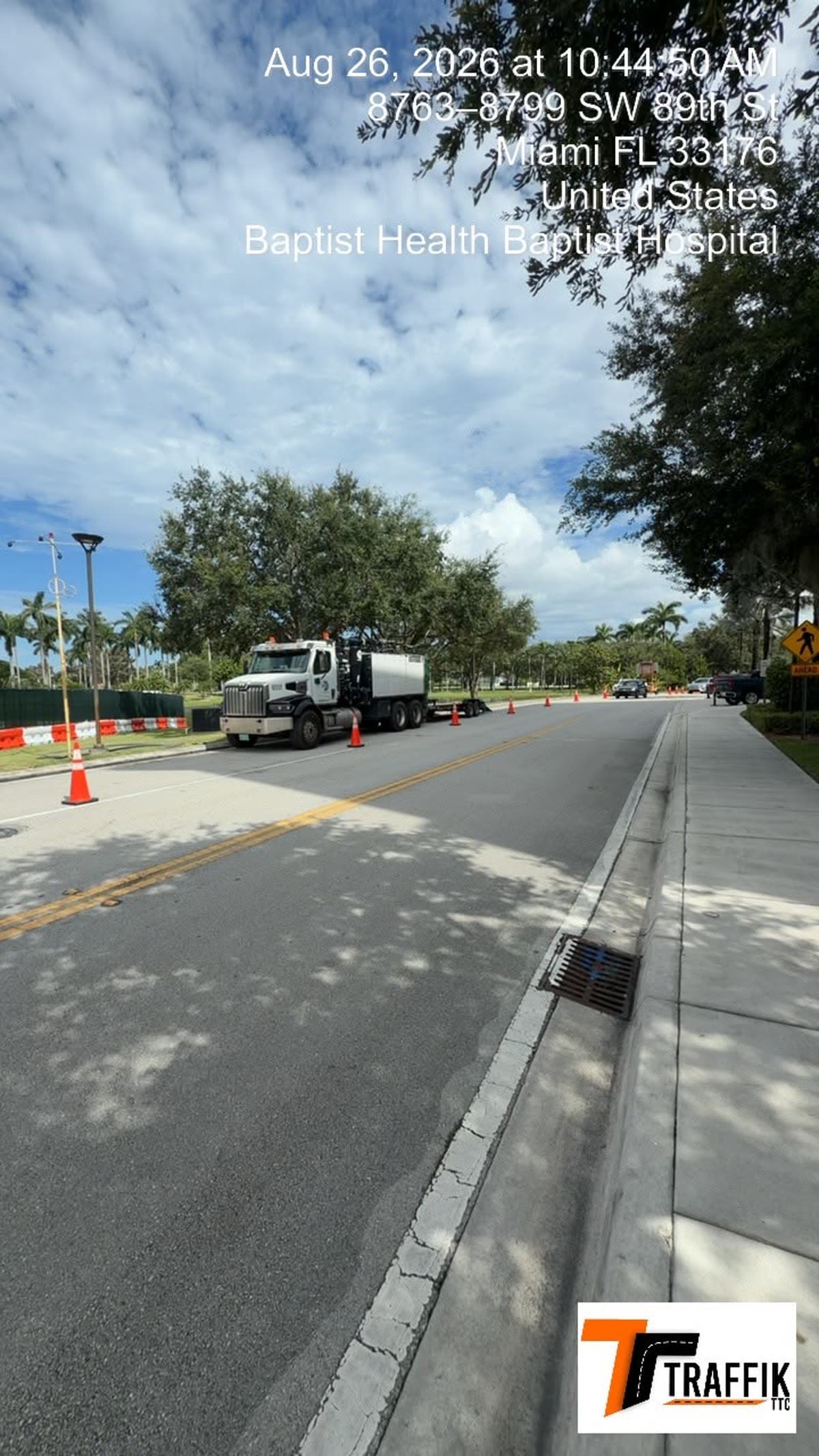
- Engineered plan drawings, ready for permit submission
- Lane closure and taper diagrams
- Sign schedules and device spacing tables
- Detour routing layouts
- Phasing plans for multi-stage work
- Flagger station and pilot car layouts
- Pedestrian and ADA accommodation routing
- Night work and reduced-visibility provisions
How it works
From first call to approved permit
- 01
Tell us about the project
The form below or one phone call. We need the work limits, the roadway, and your permit deadline.
- 02
Site evaluation
We identify the governing standard — MUTCD Part 6 plus your state and local requirements — and what the reviewer in that jurisdiction expects to see.
- 03
Plan delivered
Engineered drawings sized to your scope. Standard single-phase plans typically turn around in a few business days.
- 04
Permit and field
We answer reviewer comments on the traffic control scope. Then you build it, we rent you the devices, or our crews run it — your call.
Why Traffik
A plan from a desk fails in the field.
- Designed by people who set up work zones every day — not just CAD operators
- One accountable partner: plan, permit support, crews, and equipment
- Multi-state standard fluency: FDOT, NCDOT, and MUTCD Part 6
- Fast turnaround so the plan never becomes your critical path
Request a quote
Tell us about the project.
Six quick fields. A traffic control specialist reads it and gets back to you with what the plan involves and what it costs. In a hurry? Call (786) 775-0232 — someone answers 24/7.
FAQ
MOT plans — common questions
What's the difference between an MOT plan and a TCP?
Do I need a traffic control plan for my permit?
How fast can you deliver an MOT plan?
Can you execute a plan another engineer designed?
More questions? See the full FAQ or call (786) 775-0232.
Related services
Lane Closures
Single and multi-lane closures set up to plan spec — signs, drums, tapers, and devices placed right the first time.
Flagging
Certified flaggers with dedicated field supervision, trained and equipped for projects of every size.
Message Boards
Portable changeable message signs (PCMS) programmed, delivered, and maintained on site for advance warning drivers actually read.